
Montessori education: cultivating natural curiosity into lifelong mastery
Montessori is not a decoration or a fleeting trend — it is a time-tested, scientific approach to teaching that follows the child. Here is how that vision comes to life daily at Wania Campus.
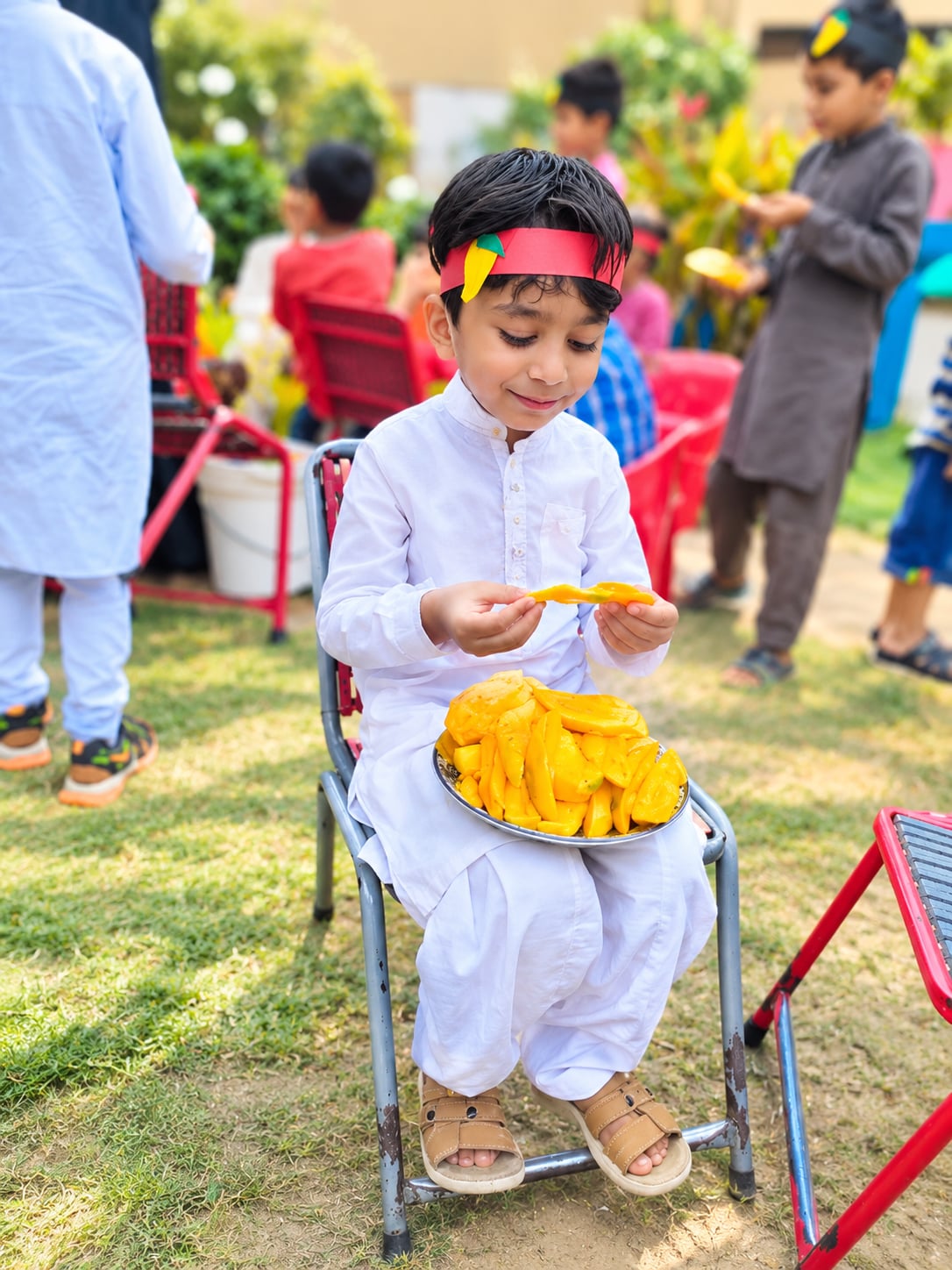
A young student enjoying a snack during an outdoor school gathering
Six foundational ideas that shape every daily lesson
Adapted from Dr. Maria Montessori's discoveries to our comprehensive curriculum in English, Urdu, mathematics, general knowledge, and moral education.
The prepared environment
Classrooms are calm, orderly, and accessible — learning materials sit on low shelves so a child can choose and return work independently.
Learning through the hands
Concrete materials precede abstract symbols. Children trace, count, balance, and sort physically before writing abstract formulas.
Freedom within clear limits
Children choose their work and how long to focus on it, within kind and consistent boundaries established with the teacher.
The teacher as guide
Montessori guides observe each child closely, introducing new challenges and materials precisely when the child demonstrates readiness.
Deep respect for the child
Every child is recognized as capable and unique. Courtesy, patience, empathy, and self-care are modeled as diligently as phonics.
Concentration and joyful work
Uninterrupted work cycles enable children to build deep concentration, finishing tasks with intrinsic satisfaction and joy.
A predictable rhythm, not a rigid factory schedule
A balanced day structured around periods of deep focus, social learning, creative exploration, and physical play.
- 1
Arrival & Assembly
Warm morning greetings, national anthem, morning assembly, and calm transition.
- 2
Montessori Work Cycle
Practical life, sensorial, language, phonics, and math activities chosen by the child.
- 3
Circle Time & Discussion
Stories, rhymes, Islamic studies, Quranic Nazra recitation, and interactive discussion.
- 4
Snack & Social Time
Healthy snack time, courtesy practice, and outdoor/indoor games.
- 5
Creative Expression
Drawing, clay art, music, physical movement, or martial arts practice.
- 6
Reflection & Close
Class tidy-up, shared gratitude, daily review, and cheerful dismissal.
Come and see a Montessori classroom in action
Visit Wania Campus and witness the calm, engaged environment where our youngest students thrive.